From a quiet prayer to a loud celebration: Mahesh Gawali leads India U20 boys back to Asia
07 Sep 2026
Akhil Rawat AIFF Media Team
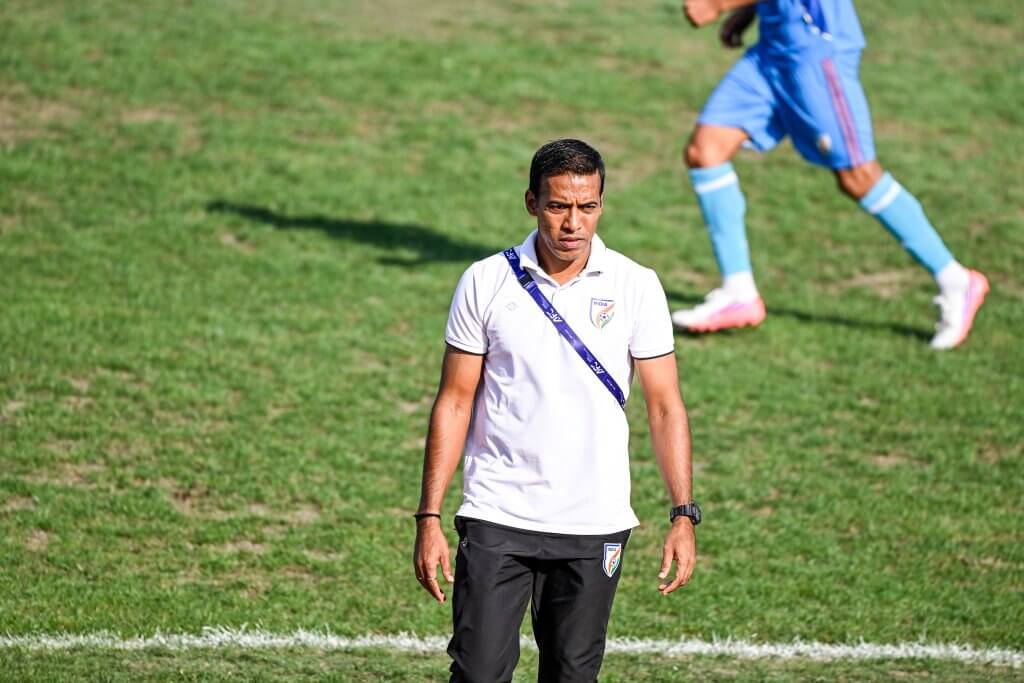
TASHKENT, UZBEKISTAN: Mahesh Gawali is usually a man of few words. Those who know him well know that. Disciplined, hardworking and understated, he was one of India’s finest defenders during a playing career that spanned almost two decades. Now, as a coach, he has led India back to the AFC U20 Asian Cup after a 20-year wait.
None of the players who achieved it on Sunday had even been born the last time India played in the tournament.
If there are three words that have become synonymous with Gawali’s speeches to his players, they are discipline, concentration and attitude. He is stern, he is demanding, and he expects a lot. But there is a difference between being strict and being harsh. Gawali is never the latter. Every now and then, he also affords that rare smile.
September 6 was a long day for the 46-year-old. It began at 1:45 PM, when the team bus departed the hotel for the Do’stlik Stadium.
By around 6 PM, India had done their part.
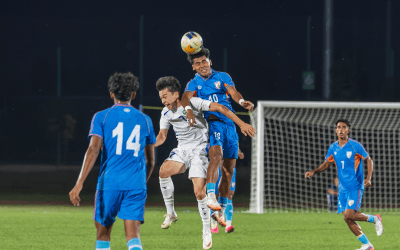
A 3-0 victory over Bangladesh meant six points from three matches and, crucially, a chance to qualify for the AFC U20 Asian Cup. But the job was not quite accomplished. Uzbekistan still had to avoid defeat against Syria in the final Group B match. Gawali stayed behind with his coaching staff.
He could have watched from the comfort of the VIP area, sitting on the shiny white leather sofas. Instead, he chose the general stands, watching every minute of the Uzbekistan-Syria encounter on the edge of his cold, half-broken plastic seat with the same concentration he had demanded from his players throughout the campaign.
When Uzbekistan eventually won 3-0, the tension finally lifted. Gawali thanked his staff and, before making his way down the stadium stairs, shared a brief prayer with them.
The Syrian staff approached him on the way out. “You deserve it. Good luck in China.”
There was warmth in the words, and Gawali responded in kind. There were also handshakes and pleasantries with Uzbekistan head coach Jamoliddin Rakhmatullaev before departing for the hotel.
The team car arrived at around 9:30 PM. By then, some of the players were already waiting outside, sitting on the porch anticipating their coaches' return.
They had been watching the match from the team hotel, streaming it on YouTube.
Gawali stepped out, and the restraint that had defined his day, or rather his entire week, disappeared.
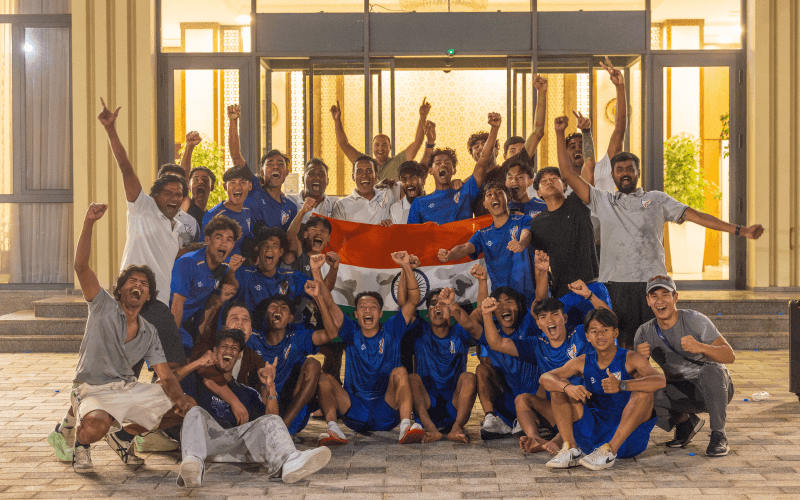
Waving the tricolour, the players gathered around their coach, and threw him into the air. Assistant coach MG Ramachandran and goalkeeping coach Parshuram Salwadi were soon pulled into the celebrations as well.
There was water flying everywhere — now an almost inevitable part of youth celebratory culture, and the Blue Colts were no different.
Even some of the Uzbek hotel staff joined in. Their own nation had qualified from the group as winners, but there was a sense that they were almost as delighted to see their guests make it through as well.
And when the celebrations were over, the players helped clean up, picking up the bottles and putting them into the dustbins.
It was a fitting end to a day that had demanded discipline, concentration and attitude from everyone.
Dinner came at 10 PM. There were a few conversations with players and staff afterwards. At around 11, Gawali finally retired to his room, and the first thing he did was video call home. His family were waiting too. The usual 'hello' was replaced by 'congratulations!'
“It is a great feeling. After a long time, after 20 years, we have qualified, and I am very proud of the boys who worked very hard. I am proud of the coaching team, which also worked very hard,” he said.
“And I am proud of the AIFF, who supported me and gave me what I wanted. I am also proud of the way we played and the moments we created, and of the football we showed.”
There had been a setback along the way — the 0-4 defeat to Uzbekistan on Thursday. But Gawali believes the team had already laid the foundations for what came next during their preparation in Bengaluru.
The four friendly matches against Singapore and Yemen (three wins and one draw) gave the players belief. In the last five weeks, the Blue Colts have played seven games and kept six clean sheets. The defender Gawali must be prouder than the coach Gawali.
“Those friendlies against Singapore and Yemen were the key moments for this team,” Gawali said. “Those games helped us understand the system and gave us confidence, and I think that played a big role in helping us beat Syria and Bangladesh.”
Against Syria, India produced one of their most important performances of not just the current campaign but perhaps the entire U20 qualifiers of the 21st century. On Sunday's decider, they lined up as favourites against Bangladesh, but Gawali's message was simple.
“Everybody knew that it was do-or-die, and I kept it very simple: play for the nation, because the nation is waiting for this and the nation is waiting for change.”
Now, this group has something no India U20 men's side has had since 2006: an opportunity to play at the continental finals. But qualification is not the destination.
“These boys are the first new generation that is going to play in the AFC U20 Asian Cup. The last time was 20 years ago. The qualification is also the start of a journey because now they have to prepare for the Asian Cup.”
The AFC U20 Asian Cup China 2027 will take place from March 24 to April 10.
“Everybody has to take care of themselves. That is very, very important. We have to focus on the U20 Asian Cup in China. Preparation is very important. We all have to work together and support the boys so that we can do better in the Asian Cup. It will be bigger, tougher, and quite an experience for the boys.”
And so, after the late goals, clean sheets, difficult moments and chaotic celebrations, a new generation has earned its turn on the Asian U20 stage.
 Shop
Shop