Akhil Rawat
AIFF Media Team
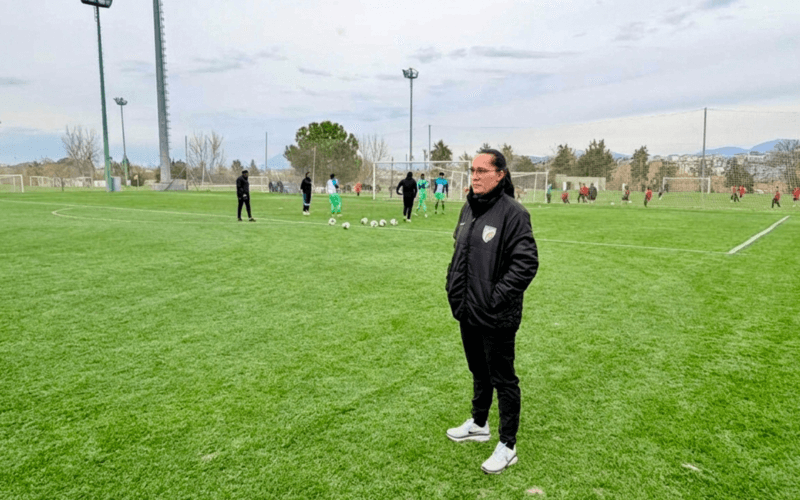
NEW DELHI: Amelia Valverde, the new coach of the Indian senior women's team, was only 23 when she began her coaching career back home in Costa Rica. Four years later, she found herself in the dugout at Montreal's Olympic Stadium, leading her country in their first-ever FIFA Women's World Cup match in 2015. They drew 1-1 with Spain. It was a commendable job by the first female head coach that Costa Rica had ever appointed. Valverde was still in her 20s.
"I like my teams to be brave," affirms Valverde.
India will be heading to the AFC Women's Asian Cup Australia 2026, looking to punch above their weight and qualify for the FIFA Women's World Cup for the first time. Bravery has to be the first word in the Blue Tigresses' dictionary.
Despite having never coached a team outside North America before, Valverde is relishing this challenge on the opposite side of the globe. All this may seem like something new for her, but in a way, it's not. She has coached at two World Cups, faced top Asian opposition before, and most importantly, knows what it's like to punch above your weight.
Valverde arrived in Türkiye to join the national team camp on Monday, 44 days before India's first match against Vietnam in Perth. But her back-to-back Mexican titles in 2024 with CF Monterrey immediately after joining the club prove that she's someone who wins races against time.
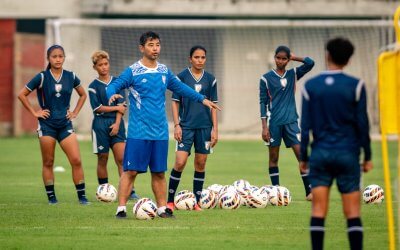
Since her arrival, Valverde has had two training sessions. The Blue Tigresses were also slated to play a friendly against Antalya Akra Spor Kulübü on January 21, but it was later called off.
With plenty to look ahead to, however, the 39-year-old spoke to the-aiff.com about embracing the challenge of leading India in pursuit of World Cup qualification, the young squad and its potential, and her philosophy of brave, united football. Valverde also emphasised on physical and mental preparation, collaboration with the coaching staff, and stressed belief, focus, and fan support ahead of the all-important Asian Cup.
Q: What motivated you to take on this challenge with the Indian national team, and what are your immediate plans with the group in Türkiye?
Amelia Valverde: First of all, I believe that when we talk about motivation in terms of a challenge, it is very important to understand what it means to have a chance to qualify for a World Cup with a team in a new confederation. It is a great responsibility. India have been doing important things in women’s football, and it has been more than 20 years since we last qualified for the Asian Cup. Now we have this opportunity to reach the World Cup for the first time.
When I was contacted (about this job), I was very detail-oriented and wanted to inform myself as much as possible, because it is a different challenge from what I am used to. But I like challenges, and this is definitely one. I believe I can contribute a lot to this team, and at the same time, they will teach me as well. That makes me very happy.
I am very pleased to have accepted this role. The immediate plan here in Türkiye is to get to know the group and make the most of the time. We actually started working two days ago, as soon as we arrived.
Q: How have the first two days been with the players and the team? What is the atmosphere like right now?
AV: They have been two days of a lot of work, but very good days as well. It is a very respectful group we have, and you can see that it is a group that has already been working. The players understand the importance of this. From my side, I have tried to get to know them as much as possible, gather as much information as I can about the players, learn about their history, and of course about the staff as well. The key right now is to create that synergy as quickly as possible.
Q: Could you tell us more about Eli Ávila (goalkeeping coach) and José Sánchez (strength and conditioning coach), who have joined with you here?
AV: Eli Ávila has worked in football for a long time. He spent more than 10 years at the Football Federation (of Costa Rica) and has been involved in many Women’s World Cups (at various levels). He has a great deal of experience, not only with goalkeepers but also with teams in general.
Eli can contribute a lot in moments where reading the game and staying calm is important. He is someone I trust deeply and who has been very close to my entire coaching journey over the years. I am very happy to have him with us. I know he will help the goalkeepers grow through his experience and his work, and we also expect that they will teach him about the potential that Indian goalkeepers have.
As for José Sánchez, he is our fitness coach. He also holds a coaching licence. He has worked in both women’s and men’s football and is extremely well-experienced. I am also very happy to be on this journey with him.
One of the most important things for us is to help players perform at the top level internationally. If there is someone I know who can help achieve that, it is him. We want players not only to compete during tournaments, but to train in a way that prepares them properly to compete.
There are important aspects related to training loads, strength work, and many other things. This is a collective effort — the physical side, technical, tactical, recovery, and goalkeeping — all working together to help the team grow as much as possible.
Q: What was your perception of the Indian team before joining, and how does it compare now? How do you view their progress?
AV: I closely follow World Cup qualification processes across different confederations, and I was already aware of the very good progress India made in Thailand last year. When I had my first contact, I started gathering more information.
I believe the country is making an important effort to grow the national team and giving players, even those who may not be fully professional, experiences closer to high-level competition.
This is a very brave team. Everyone works very well. It is also a young team, which I believe is an advantage. That was my initial perception, and now that I am here, it has been confirmed.
Q: What kind of footballing philosophy are you planning to bring into the team? What kind of football can we expect to see under you?
AV: First of all, I like my teams to be very brave. I like teams that are united and supportive, both on and off the pitch, both defensively and offensively. No one is above the team. All players are important, whether they are on the pitch or not.
I also like teams that are aggressive going forward. This particular team has players of great quality, especially when attacking at speed, and we want to exploit that. We want to be a very organised and compact team, and when we recover the ball or have possession, we want to attack with intensity.
Q: You have just over a month before the Asian Cup. How do you plan to implement your ideas, and where do you think the team stands right now?
AV: In this case, we are in a race against time, as people say. We have to focus on today, on the energy, and on strengthening everything that already exists within the team. We want to raise the team’s intensity and improve them physically. We do have time to work on that. If we focus too much on whether the time is short or long, we might not give this process the energy it truly deserves.
Q: Based on your World Cup experience with Costa Rica and facing Asian teams, what will be key for India at the Asian Cup?
AV: The first key is to have faith in the team’s identity and in the players. It is a very quick team, and it can become even quicker in attack. Concentration will be crucial.
I have played against Asian teams like Philippines, Japan, and China. These are very consistent teams. To counter them, we must be equally organised and clearly identified in our style. Mentally, we must be very strong. Matches in these tournaments at such a high level are usually very tough and tight. Any moment can decide a game, so we must stay focused.
At the same time, belief is essential, believing that at any moment something can happen in our favour. This competition is built every day, mentally, physically, and in all areas, so that when the moment arrives, we can deliver our best possible performance.
Q: What inputs have coaches Crispin Chettri and Priya PV given you? What has the conversation been so far among the coaches there? How is the coaching collaboration working?
AV: For us, as technical staff, it is very valuable that coaches Crispin (Chettri) and Priya (PV) are here. They have been with the players for a long time. Our responsibility now is this camp in Türkiye, then the Asian Cup in Australia. Given the time we have, we need as much information as possible from those who know the players best. The coaches have been very open and supportive. We talk constantly to analyse player profiles and discuss different approaches.
We have to build a team within the team, technically speaking. Crispin and Priya, the three of us, coach Mario (Aguiar) with the goalkeepers now complemented by Eli (Ávila). Their presence is extremely important due to their experience and long-term involvement. Our task is to combine all that knowledge and energy to help this group grow as much as possible.
Q: Why and how did you shift from a player to a coach at a very young age? You were just 28 when you coached Costa Rica in their World Cup debut. How has your journey been so far?
AV: I stopped playing at 22 or 23 because I decided to. Women’s football in Costa Rica was not professional at the time. Our coach left the team, and a teammate suggested why don't we take over. I was a physical education teacher and had already been coaching youth teams, so I decided to do it. I never imagined it would lead me here. After two years, the federation (FCRF) called me, first as a fitness coach, then as an assistant.
I never imagined I would spend 13 years at the federation, go to three World Cups (twice senior and once U20), and later have the chance to coach a club abroad. It has been a great honour. I feel very fortunate. This opportunity with India confirms that life and football have been very good to me, and this is no exception. The opportunity to coach a national team abroad, to have the chance to coach on a different continent and in World Cup qualifiers, that's what attracted me to this. I was given the opportunity, and well, here I am, practically 18 years later. I feel very happy to have this opportunity to represent India in the Asian Cup and the World Cup qualifiers.
Q: If you had to choose your favourite moment in your coaching career so far, what would it be?
AV: I have two. The first was qualifying Costa Rica for the 2023 World Cup in Australia and New Zealand. The second would be the two league titles with Monterrey. Those days were very special, some of the happiest days of my career. I hope to experience moments like that again very soon.
Q: What message would you like to give to the fans in India?
AV: First, we need all of your positive energy and good vibes. The team and the players are doing a very good job. The dreams and the hopes are alive. We are working as hard as possible to represent this great country in the best possible way. We know the responsibility we carry, and we hope to be able to give the fans all the happiness.
 Shop
Shop